Kleiwerks International - Haiti Sustainability Project
Kleiwerks International - Haiti Sustainability Project - 501(c)3
Hikers: 27
Sponsors: 162
Pledged: $15222.88
Hiked: $6725.09
Donated: $6393.45
Kleiwerks has been on the ground in Haiti since February 2010. Our primary goal is to improve long-term security on behalf of the Haitian people by offering training and technical support to individuals, organizations and communities that are interested in sustainable technologies. We are currently partnering with Haitian leaders, NGO's, and the international community to build capacity around shelter, water and food systems that are replicable, sustainable, and affordable. visit site
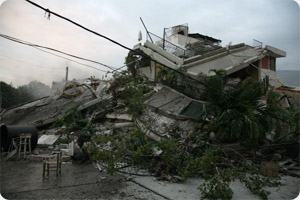
In the aftermath of the earthquake as many as one
million Haitians have been left homeless.
Haiti will need to be completely rebuilt from the
ground up, according to a journalist, as "even in good times,
Haiti is an economic wreck, balancing precariously on
the razor's edge of calamity."
Many countries responded to appeals for humanitarian aid,
pledging funds and dispatching rescue and medical teams,
engineers and support personnel. On 22 January the United
Nations noted that the emergency phase of the relief operation
was drawing to a close, and on the following day the Haitian
government officially called off the search for survivors.
Long after international disaster relief and aid
funds for Haiti stop flowing, the majority of
Haitians will still be living in extreme poverty.
The economic and political conditions which created
a state of poverty for Haiti before the quake persist.
We believe the best long term solutions are those which
will empower the Haitian people to take care of themselves.
We consulted with members of the Natural Building
Network to find a non-profit organization that we felt
could put the funds raised to most effective use aiding
Haitians with long term solutions. We're excited to
have found Kleiwerks International as after significant
discussion we're convinced their experience and comittment
will make our collective donations go far in Haiti.
The funds raised via Hikefor will be used
to finance a building/education project
in Haiti by Kleiwerks International. Funds will specifically
finance the following:
Training of Haitian leadership trainers
Haitian architect re: building design
Site preparation and construction
Building materials
An introduction to Kleiwerks International
Community expectations: We are careful not to build false expectations amongst the Haitian communities we work with until funding is secure. Now that we're this far along with HikeFor, we are in detailed conversation with local leaders and partners. For now, here's what we know:
Training: Will include women, men, and youth community leaders from the Tabarre neighborhood of Port au Prince. There will be a survey process in which training participants are selected in small groups based on their commitment to share what they learn with their extended communities. Our approach is one that helps communities build their own capacity to help themselves vs. a hand-out approach.
Project: The building will serve a significant community need currently being clarified by the people who live in the neighborhood. The building must be completed during the training so that trainees get a comprehensive, hands-on experience that includes every phase of the building process.
Design: A Haitian woman architect named Regine will design the building. Regine is one of our main colleagues, and is a pioneer of sustainable reconstruction in Haiti. The building will be based on refinements of commonly known construction methodologies so that it's culturally appropriate and transferable.
Materials: Will be based on that which is locally available and affordable.
Live updates: We will use our blog, website, and social media to share visual and written updates of the process. We'll be happy to acknowledge HikeFor and it's contributors as the main sponsor of the training.
The way our programs work, and the most empowering approach we can take in Haiti (and elsewhere)
is to engage the community in defining their own priorities. Once funding is available, community
groups will gather to determine which project will serve them best based on the parameters laid out
below. I hope the description of our process (below) helps donors understand this project's dedication
to be an empowering process for the local people.
Projects, programs, and participants
Kleiwerks International's building projects serve significant community needs that local community
members determine themselves. The training programs help community groups build their own capacity
to serve themselves vs. perpetuating a "hand-out" victim mentality. The training participants are
leaders of local orphanages, schools, churches, and other groups who will replicate and share what
they learn in the training with their respective communities.
Values
Our commitment, first and foremost, is to an uplifting community-building process that creates connectivity and cooperation vs. competition for resources and a "hand-out" victim mentality.
The building that gets constructed is based on what local groups determine will serve their community's greatest good.
"Stakeholders" are the Haitian women, men, and youth leaders who live and work in the local community.
Project selection is based on a structure that serves the greater good, is replicable, affordable, uses locally-available materials, can be completed within the means of the program budget and timeline, and create replicable models that improve local building knowledge.
Program and project results are experienced directly by the participants, and their community-at-large, while also serving long-term needs.
Follow-up projects that training participants will create in their respective communities are identified by their community beforehand so that there are clear next steps for leadership, community engagement, and replication of building technologies.
Process
Because of our existing community connections, stakeholders have already been identified and the relationships are established. This enables us to begin right away with Step 1:
1/2 day -- Community Stakeholder Meeting, including representatives from local schools, orphanages, churches, and other community groups (by end of November)
2-weeks -- Project identification and design, and Training participant selection process (by mid-December)
5-7 days -- Training program and Project construction (begins early January)
Documentation (ongoing)
Kevin Rowell, Situation in Haiti, June 2010
More on Natural/Sustainable Building
Give someone a fish
feed them for a day.
Teach someone to fish
feed them for a lifetime.
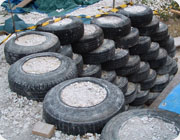
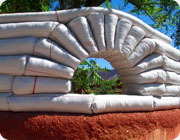
Here's an example of one effective building technique
which takes little more than earth and burlap bags.
Natural building involves a range of
building systems and materials that place major emphasis
on sustainability and use of local resources.
Natural building techniques are also easily learned, and
natural homes can be very inexpensive to build. These
are just a few of the reasons why these building techniques
can be effective solutions in impoverished areas.
A few natural building techniques and technologies:
If you haven't seen the film Garbage Warrior, you should! The Earthship team
has experienced first hand how impactful these solutions can be for survivors in
areas devastated by natural disasters. It's educational, but also simply a great film.